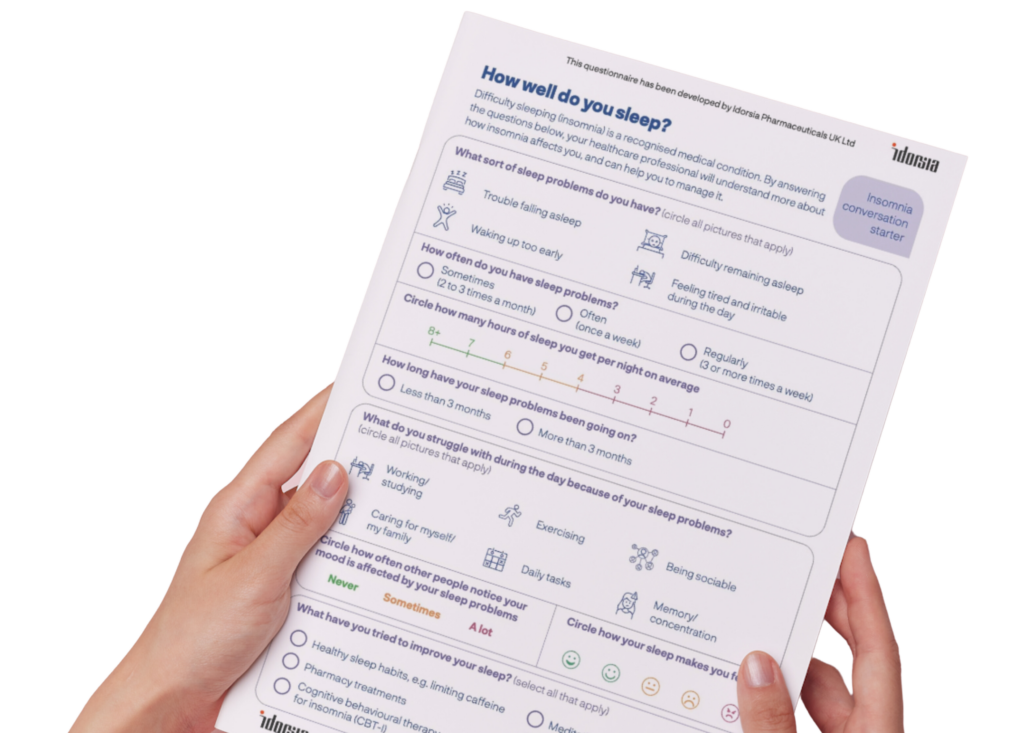
So, you want to know what insomnia is?
- Chronic insomnia is a sleep disorder where individuals struggle falling asleep, staying asleep, or waking up too early at least 3 nights a week for over 3 months.1,2
- Chronic insomnia can cause fatigue, irritability, concentration problems, low sociability, and reduced work performance during the day.1
- The brain may remain overly active at night, preventing proper sleep and leading to daytime tiredness.3,4
How do you define chronic insomnia?
Here's what we know
Many of us go through times when we have trouble sleeping. This is known as insomnia. The meaning of the word is, literally, ‘without sleep’.
But, for some people, insomnia goes way beyond that. It becomes something that lasts for at least 3 months and leaves people tired during the day.1,2
This is chronic insomnia, and it’s a recognized medical disorder.1
When you have difficulties falling asleep (sleep initiation) or staying asleep (sleep maintenance) for a long time, you’re unable to get restorative sleep.1,2 This means you may feel tired and not really at your best during the day.3,4
Sometimes, people live with it for years.
What’s going on when you have chronic insomnia?
Well, the science suggests that people with chronic insomnia have an overactive brain at night, and research has helped us to better understand what’s going on.3,4
Parts of the brain that should be in sleep mode are instead still active, making it hard to fall asleep and stay asleep until morning.3,4
Without restorative sleep, you may feel tired and really not at your best during the day.3,4
What can be done to help your chronic insomnia?
Common advice has probably told you to avoid caffeine, use lavender sprays or give relaxation techniques a go.
With so much advice and so many treatments available, it can be hard to find the right thing that works for you. Not everyone is going to be able to complete cognitive behavioural therapy, or they may find that prescription medicines leave them feeling drowsy in the day.5
So, what can you do to help get better sleep?
The good news is we know a lot more about what’s going on with chronic insomnia.
With a better understanding of it, we have new ways of thinking about how to manage chronic insomnia and get the restorative sleep we need to be at our best during the day.6-9
Feeling alone with chronic insomnia?
We all know how terrible we feel when we get a bad night’s sleep, but what’s it like when you have chronic insomnia? When you haven’t slept well for months, or even years? That terrible feeling is pretty much a daily reality. You just cannot catch up on sleep.
You’re not alone in feeling like this though. About 1 in 10 people are going through exactly the same thing. It’s hard to live this way.10

How does chronic insomnia impact your day?
Here are some of the common daytime symptoms of chronic insomnia1,11

Fatigue

Bad work/school performance

Low sociability

Poor concentration

Irritability and bad moods

Negativity for caregivers or family

Morning sleepiness
Why me? Why do some people get chronic insomnia?
Some people are more at risk of chronic insomnia than others
Age
Did you know that your risk for insomnia and sleep problems increases as you get older?2
2022 data from the Sleep Foundation shows that
30% to 48%
Of older adults suffer from insomnia SYMPTOMS 12
Why? Well, it’s thought that the systems in the brain that control sleep don’t work so well as we get older.2
The menopause
Another group disproportionally affected are those who are going through the menopause.14
In fact, about 4 in 10 may have insomnia by the time they reach the end of menopause, possibly due to declining estrogen levels.13,14
Stressful triggers
Insomnia can also be caused by an event or traumatic experience – we call these triggers. They could be something obvious like a stressful time at work, losing someone you love, or being involved in an accident.15
Triggers are events or conditions that cause you to lose sleep. Often, once these triggers and experiences resolve themselves or as time passes, people are able to sleep again.17 But this isn’t the case with chronic insomnia.15
Poor sleep habits
Whether you do it consciously or subconsciously, you might start changing your behaviors and habits to make up for not sleeping at night.15 This could be trying to nap during the day, drinking more caffeine or simply worrying about the sleep you’re not getting.15
Eventually, these habits and changes could become counterproductive and start working against you and may play a role in continuing your chronic insomnia.15
When does insomnia become chronic?
There are two types of insomnia and cases of acute insomnia can, in fact, develop into chronic insomnia. The main difference between the two types comes down to how long your trouble sleeping has been going on for.1,10,11,16
When someone has insomnia, it’s usually because something has triggered it. This could be something like stress about work, anxiety about money, or grief from losing a loved one.15 Once these triggers resolve, or as time passes, most people are able to sleep again.1,10,11,16 This is known as acute insomnia.1,10,11,16
Chronic insomnia happens when insomnia symptoms last for 3 months or longer. In a lot of cases, even if the triggers that originally caused insomnia resolve, you may still not be able to sleep.1,10,11,16
About 1 in 10 people suffer from chronic insomnia.10 So, if you’re living with any of its symptoms, know that you’re not alone.
Differences between acute and chronic sleep disorders1,10,11,16
- You’ve had trouble sleeping at least 3 times a week for less than 3 months
- If the trigger resolves, then your insomnia usually also resolves
- You’ve had trouble sleeping at least 3 times a week for at least 3 months or more
- Even if the trigger resolves, you still struggle with insomnia
What does an overactive brain have to do with chronic insomnia?
An active and alert brain is brilliant during the day, isn’t it?
An active brain telling you to stay awake at night? Not so good. Who wants to be wide awake thinking about your to-do list, when you could be dreaming about desert islands and giving your brain the rest it needs?
So, what’s happening then?
Well, the science suggests that people with chronic insomnia have an overactive brain at night, and research has helped us to better understand what’s going on.3,4
Parts of the brain that should be in sleep mode are instead still active, making it hard to fall asleep and stay asleep until morning.3,4
This lack of restorative sleep can leave people feeling tired and really not at their best during the day.3,4

Knowledge is key when managing chronic insomnia
Now that we know more about what’s going on in chronic insomnia, we can rethink how to manage it.
We can also understand why some approaches may not be the answer.17
Because although some insomnia medications have a sedative effect, which work by making you feel drowsy, they don’t give you the right kind of sleep you need to feel rested during the day.18
With a better understanding of chronic insomnia, we have new ways of thinking about how to manage it and get the restorative sleep you need to be at your best during the day.6–9
Sleep: why it matters and what gets in its way
Let’s start with a simple fact. We need sleep as much as we need food, water and air.19,20 We can’t live without it.19,20
But why do we sleep? Why is it so important?
It’s something that’s fascinated us for thousands of years. Sleep even has its own awareness day, World Sleep Day, which occurs in March each year.
Why sleep is so good for us
Here are some of the common daytime symptoms of chronic insomnia1,11

Brain function
Sleep helps us to think, learn and make memories.20 These things can all be negatively affected after being awake for a long time.20

Metabolism
There’s evidence that when we have enough sleep, we can better manage our blood sugar levels as well as other hormones that regulate things like hunger during the day.20–22 In fact, a recent 2022 article from the Sleep Foundation reported that sleep loss is a risk factor for obesity.23

Immunity
Sleep gives our immune system a helping hand.24
In a 2022 article, researchers found that when adults get a recommended amount of sleep each night, there’s a reduced risk of catching infections and an improved response to vaccinations.24

Mental health
The theme of World Sleep Day 2022 was ‘Quality Sleep, Sound Mind, Happy World’. This makes perfect sense, because a bad night’s sleep reduces our ability to manage our emotions and impulses, increases worry and even worsens depression.1,11,25

Growth, repair and recovery
From helping us recover from injuries to growing the hair on our heads, sleep is essential for the growth, repair and recovery of our bodies.26
Why sleep is so good for us
Brain function
Sleep helps us to think, learn and make memories.20 These things can all be negatively affected after being awake for a long time.20
Metabolism
Immunity
Mental health
Growth, repair and recovery
Here’s what happens when we sleep
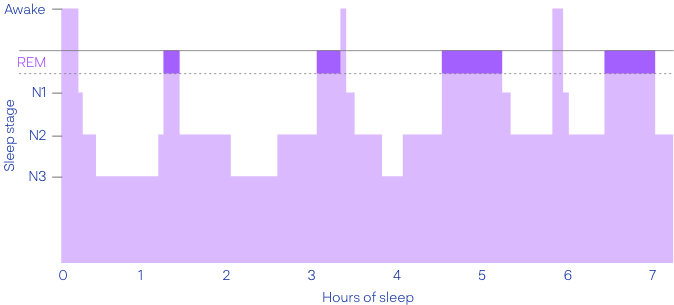
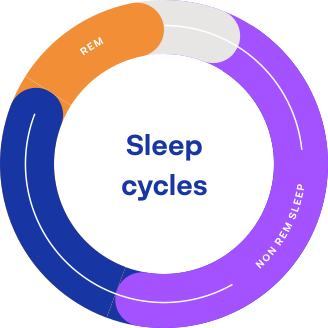
Sleep is not simple. It’s not a single, linear process – it’s a complex series of approximately 90-minute cycles that go through four main stages.27
These stages matter because a lack of time spent in each one can impact our thinking, emotions, and even our overall physical health.27
Each stage of sleep helps us in different ways. This is why it’s important to spend enough time asleep so that your brain can go through all the stages in each cycle to help you feel at your best during the day.27
The different sleep phases
Science suggests that people with chronic insomnia have an overactive brain at night, and research has helped us to better understand what’s going on.3,4
Parts of the brain that should be in sleep mode are instead still active, making it hard to fall asleep and stay asleep until morning.3,4
Without restorative sleep you may feel tired and really not at your best during the day.3,4
Light sleep (N1)
This stage – as the name suggests – is the lightest stage of sleep.27
Your muscles are still slightly engaged, meaning you haven’t totally relaxed yet and you’re breathing regularly. This stage tends to last 1 to 5 minutes, which means it only accounts for less than 5% of each 90-minute cycle.27
Moderate sleep (N2)
At this point, you’re getting ready to go into deep sleep. Your heart rate and body temperature drop. Your brain will also put out short bursts of activity that only last for a second, which means you’re drifting into deep sleep.27
This stage lasts around 25 minutes in the first sleep cycle and then gets longer with each successive cycle, eventually consisting of about 50% of your total sleep.27
This stage helps with memories.27
Deep sleep (N3)
This is the deepest stage of sleep and is the most difficult to wake up from. For some people, even loud noises over 100 decibels won’t wake them! Deep sleep typically takes up about 20% of sleep but, as people get older, they tend to spend less time in this sleep stage and more time in moderate sleep.27
This stage helps repair the body
and strengthen immunity.27
Rapid eye movement (REM) Sleep
This is the stage people tend to remember – it’s when we dream. Nearly all our muscles, except for ones that move our eyes and keep us breathing, are completely relaxed and don’t move.27
When you’re dreaming, your breathing rate is irregular. You typically don’t go into REM in the first sleep cycle, and when you do in the second cycle, REM only lasts for 10 minutes. This increases though, and an adult usually spends about 2 hours a night in REM sleep.27
This stage helps with learning.28
How much time people typically spend in each sleep stage throughout the night

How much restorative sleep do I actually need?
While it’s well known that most adults need about seven to nine hours of sleep per night, the quality of your sleep matters just as much as the amount.6
If you sleep for the recommended amount of time, but you wake up multiple times during the night and then struggle to get back to sleep again, the quality of your sleep may not be good enough.29 This can mean you’re not getting the right kind of sleep you need to feel rested during the day.29 Plus, you may not be experiencing all of the health benefits that sleep has to offer.29
Sleep is a very individual thing.
To help you figure out if you’re getting not only enough sleep but also good quality sleep, consider your health, activity levels, and typical sleep patterns. Here are some questions you may want to ask yourself:
- Do I feel re-energized and look forward to the day when I wake up in the morning?
- Do I spend a lot of energy during the day – e.g. do a lot of sport or have a job that involves a lot of physical activity?
- Am I able to think clearly at work and carry out tasks efficiently?
- Do I sleep for longer on the days when I’m not at work?
Take a look at how well you are currently sleeping and adjust based on your answers to the questions – this will help you figure out your optimal amount of sleep.
Why don’t you get the restorative sleep you need with chronic insomnia?
Science suggests that people with chronic insomnia have an overactive brain at night, and research has helped us to better understand what’s going on.3,4
Parts of the brain that should be in sleep mode are instead still active, making it hard to fall asleep and stay asleep until morning.3,4
Without restorative sleep you may feel tired and really not at your best during the day.3,4
What’s next for managing chronic insomnia?
The good news is that now we know more about what’s going on in chronic insomnia, we can rethink how we manage it.
We can also understand why some approaches may not be the answer.5
Because although some insomnia medications have a sedative effect, and work by making you feel drowsy, they don’t give you the right kind of sleep you need to feel rested during the day.18
With a better understanding of what happens when we have an overactive brain at night, we have new ways of thinking about how to manage chronic insomnia and get the restorative sleep you need to be at your best during the day.6–9
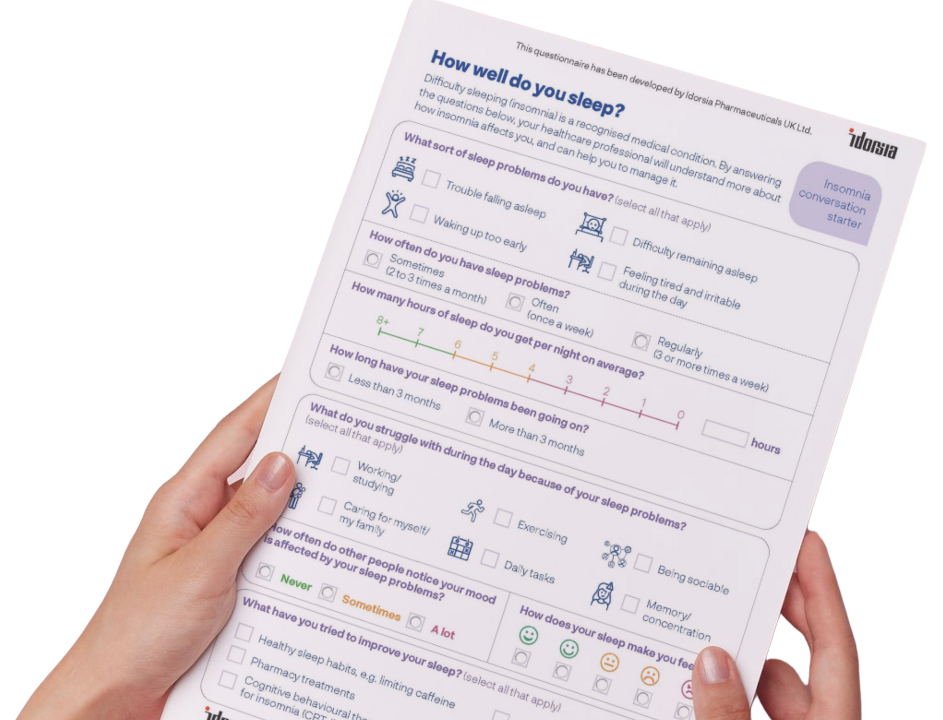
Ready for a fresh conversation about chronic insomnia?
References
1. Reimann D, et al. J Sleep Res. 2017; 26(6): 675–700.
2. Roth T. J Clin Sleep Med. 2007; 3(5 suppl): S7–S10.
3. Riemann D, et al. Sleep Med Rev. 2010; 14(1): 19–31.
4. Killgore, et al. Neuroreport. 2013; 24(5): 233–40.
5. Winrow CJ and Renger JJ. British J of Pharm. 2014; 171(2): 283–293.
6. Chaput JP, et al. Nat Sci Sleep. 2018; 10: 421–430.
7. El-Mekkawy L, et al. Egypt J Neurol Psychiatry Neurosurg. 2022; 58(1): 1–7.
8. Drake CL, et al. J Clin Sleep Med. 2014; 10(7): 733–741.
9. Schutte-Rodin S, et al. J of Clin Sleep Med. 2008; 4(5): 487–504.
10. Vargas I, et al. Brain Sci. 2020; 10(2): 71.
11. Ellis JG, et al. J Psych Res. 2012; 46: 1278–1285.
12. Sleep Foundation. Sleep Statistics. Available at: https://www.sleepfoundation.org/how-sleep-works/sleep-facts-statistics. Accessed August 2022.
13. Mallampalli MP and Carter CL. J Womens Health. 2014; 23(7): 553–562.
14. Pengo MF, et al. Chest. 2018; 154(1): 196–206.
15. Wright CD, et al. Front Psychol. 2019; 10: 2498.
16. Basta M, et al. Sleep Med Clin. 2017; 2(2): 279–291.
17. Krystal AD, et al. Psychiatr Clin North Am. 2015; 38(4): 843–860.
18. Bastien CH, et al. Sleep. 2003; 26(3):313–7.
19. Grandner MA. Sleep Med Clin. 2017; 12(1): 1–22.
20. Medic G, et al. Nat Sci Sleep. 2017; 9: 151–161.
21. Sharma S and Kavuru M. Int J Endocrinol. 2010;2010:270832.
22. Copinschi G, et al. Front Horm Res. 2014; 42: 59–72.
23. Sleep Foundation. Obesity and Sleep. Available at: https://www.sleepfoundation.org/physical-health/obesity-and-sleep. Accessed August 2022.
24. Schmitz NCM, et al. Clocks & Sleep. 2022; 4: 66–79.
25. Matricciani L, et al. Sleep Health. 2018. 4(4): 339–348.
26. Vyazovskiy VV. Nat Sci Sleep. 2015; 7: 171–184.
27. Patel AK, et al. Physiology, Sleep Stages. In: StatPearls[Internet]. Treasure Island (FL): StatPearls Publishing; Jan 2022.
28. Harvard Medical School. Improving Sleep: A guide to a good night’s rest.
29. Nelson KL, et al. Nurs Forum. 2022; 57(1):144–151.
EUC-IDS-00086 l April 2025