How is chronic insomnia diagnosed?
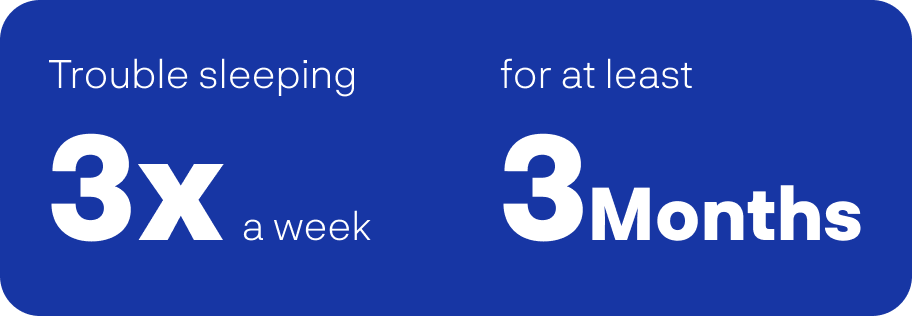
- Chronic insomnia is a recognized medical disorder that lasts at least 3 times a week for 3 months or more.1,2 Talk to your doctor about any symptoms.
- Your doctor may ask you to track your sleep patterns and share your medical history to rule out other sleep disorders.3,4
- Risk factors for chronic insomnia include age, menopause, and stressful triggers.5,6
Everyone has trouble sleeping now and then. But when trouble sleeping becomes something that lasts for at least 3 times a week for 3 months or longer, it’s known as chronic insomnia.1,2
Chronic insomnia is a recognized medical disorder,1 which is why it’s important to tell your doctor about any symptoms you may be experiencing.

Chronic insomnia not only affects nighttime sleep
– it can also significantly impact daytime activities.

Everyone has trouble sleeping now and then. But when trouble sleeping becomes something that lasts for at least 3 times a week for 3 months or longer, it’s known as chronic insomnia.1
- Difficulty falling asleep at night3,4
- Repeatedly waking up earlier than you want to3,4
- Difficulty staying asleep and waking up in the middle of the night3,4

- Morning sleepiness1
- Poor concentration1
- Tiredness6
- Low performance 1,6
- Memory loss1
- Irritability and bad moods6
- Feeling anxious6
Everyone has trouble sleeping now and then. But when trouble sleeping becomes something that lasts for at least 3 times a week for 3 months or longer, it’s known as chronic insomnia.1
Poor sleep also affects your daytime activity. If you don’t get enough restful sleep at night, it can result in:
- Morning sleepiness1
- Poor concentration1
- Tiredness6
- Low performance 1,6
- Memory loss1
- Irritability and bad moods6
- Feeling anxious6
What insomnia symptoms should I talk to my doctor about?
There are some symptoms of insomnia, like trouble falling or staying asleep, that are more obvious than others.
It’s important to tell your doctor if you are experiencing any of the nighttime and daytime symptoms of insomnia mentioned above as this is the only way they’ll know if you’ve got chronic insomnia or not.3
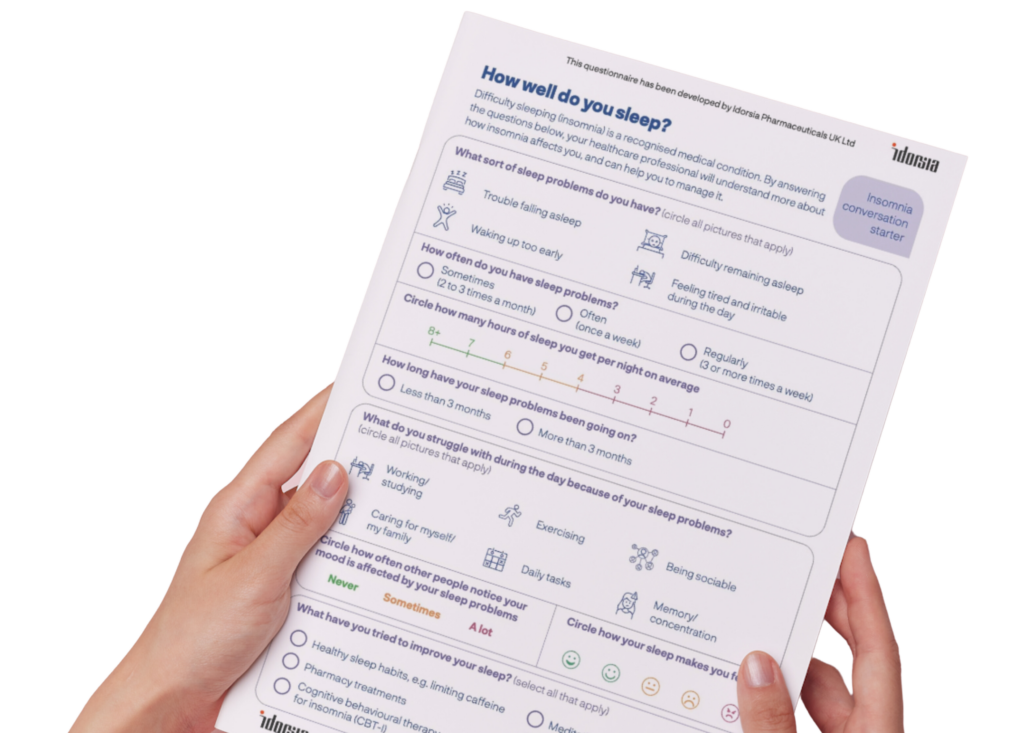
Plus, they may ask you to track your sleeping patterns for a few weeks and share your medical history with them so they can get a better picture of you and your relationship with sleep.3,4 This will also help exclude any other sleep disorders so they can determine if it is chronic insomnia or something else you may be suffering with.3,4
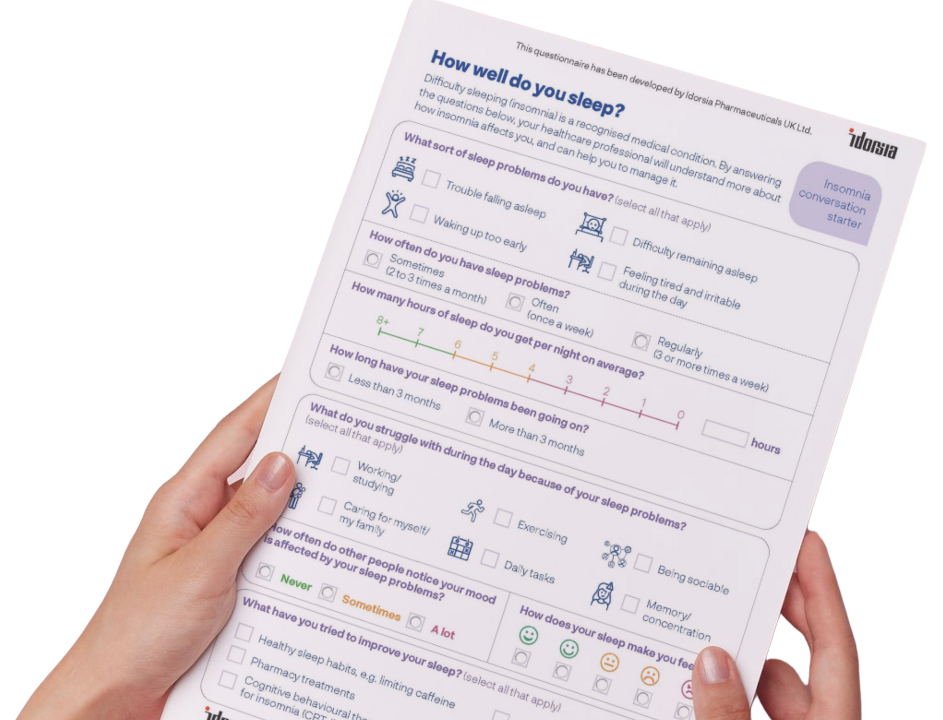
Some physicians do this by using tools or questionnaires.
Learn more about your sleep and the science behind chronic insomnia.
Am I at risk of having chronic insomnia?
Insomnia affects people differently, and some are more likely to experience it than others.6
Let’s take a look at some of the things that may increase your risk of insomnia. Your doctor should look out for these risk factors during your appointment.
Age
Did you know that your risk for insomnia and sleep problems increases as you get older?2
2022 data from the Sleep Foundation shows that
30% to 48%
Of older adults suffer from insomnia SYMPTOMS 12
Why? Well, it’s thought that the systems in the brain that control sleep don’t work so well as we get older.2
The menopause
Another group disproportionally affected are those who are going through the menopause.14
In fact, about 4 in 10 may have insomnia by the time they reach the end of menopause, possibly due to declining estrogen levels.13,14
Stressful triggers
Insomnia can also be caused by an event or traumatic experience – we call these triggers. They could be something obvious like a stressful time at work, losing someone you love, or being involved in an accident.15
Triggers are events or conditions that cause you to lose sleep. Often, once these triggers and experiences resolve themselves or as time passes, people are able to sleep again.17 But this isn’t the case with chronic insomnia.15
Poor sleep habits
Whether you do it consciously or subconsciously, you might start changing your behaviors and habits to make up for not sleeping at night.15 This could be trying to nap during the day, drinking more caffeine or simply worrying about the sleep you’re not getting.15
Eventually, these habits and changes could become counterproductive and start working against you and may play a role in continuing your chronic insomnia.15
Worried about chronic insomnia? Here’s what to do next
The next time you visit your doctor about your insomnia, make sure to let them know about any nighttime or daytime symptoms you may be experiencing.
This is important because it’s the only way they’ll know if you’ve got insomnia or not!3,4
In the meantime, here’s some information about tests and evaluations that may be carried out by your local healthcare provider.
Prepare for your doctor’s visit with our conversation starter by getting the guide
Ready for a fresh conversation about chronic insomnia?
References
1. Reimann D, et al. J Sleep Res. 2017; 26(6): 675–700.
2. Vargas I, et al. Brain Sci. 2020; 10(2): 71.
3. Ellis JG, et al. J Psych Res. 2012; 46: 1278–1285.
4. Basta M, et al. Sleep Med Clin. 2017; 2(2): 279–291.
5. Wright CD, et al. Front Psychol. 2019; 10: 2498.
6. Roth T. J Clin Sleep Med. 2007; 3(5 Suppl): S7–S10.
7. Sleep Foundation. Sleep Statistics. Available at: https://www.sleepfoundation.org/how-sleep-works/sleep-facts-statistics. Accessed August 2022.
8. Mallampalli MP and Carter CL. J Womens Health. 2014; 23(7): 553–562.
9. Pengo MF, et al. Chest. 2018; 154(1): 196–206.
10. Riemann D, et al. Sleep Med Rev. 2010; 14(1): 19–31.
11. Killgore, et al. Neuroreport. 2013; 24(5): 233–40.
12. Medic G, et al. Nat Sci Sleep. 2017; 9: 151–161.
13. Ryu HS, et al. Clin Otolaryngol. 2016; 1(4):395–401.
14. Bassetti CLA, et al. Nat Rev Neurol. 2019; 5(9):519–539.
15. Wickwire EM, et al. Chest. 2017; 151(5): 1156–1172.
16. Eastman CI and Burgess HJ. Sleep Med Clin. 2009; 4(2): 241–255.
17. Singh S, et al. Cureus. 2018; 10(12): e3807.
18. Ekbom L and Ulfberg J. J Intern Med. 2009; 266(5):419-431.
19. Winrow CJ and Renger JJ. British J of Pharm. 2014; 171(2): 283–293.
20. Chaput JP, et al. Nat Sci Sleep. 2018; 10: 421–430.
21. El-Mekkawy L, et al. Egypt J Neurol Psychiatry Neurosurg. 2022; 58(1): 1–7.
22. Drake CL, et al. J Clin Sleep Med. 2014; 10(7): 733–741.
23. Schutte-Rodin S, et al. J of Clin Sleep Med. 2008; 4(5): 487–504.
EUC-IDS-00086 April 2025