What causes insomnia?
- Research suggests that an overactive brain at night makes it difficult to fall and stay asleep.1,2
- Certain factors like age, menopause, and life stressors can increase the risk of chronic insomnia.3-5
What’s behind chronic insomnia?
Many of us go through times when we have trouble sleeping, and we often know the reason why. It could be something like a stressful time at work, or the grief of losing a loved one.6
But when you live with chronic insomnia, it can be hard to know the reason why you’re not sleeping.
Unlike acute insomnia, which tends to last for less than 3 months and stops when the cause (often called a trigger) resolves, chronic insomnia can go on for 3 months or longer and carries on even when the trigger resolves itself.3,7-9
Here’s what we know about the cause of chronic insomnia
The science suggests that people with chronic insomnia have an overactive brain at night, and research has helped us to better understand what’s going on.1,2
So, what’s going on?
Parts of the brain that should be in sleep mode are instead still active, making it harder to fall asleep and stay asleep until morning.1,2
Without restorative sleep you may feel tired and really not at your best during the day.1,2
The good news is now we know more about what’s going on with chronic insomnia, we can rethink how to manage it.
When it comes to chronic insomnia, some people are more likely to have it than others
Let’s take a look at some of the things that may increase your risk of insomnia.
Age
Did you know that your risk for insomnia and sleep problems increases as you get older?3
2022 data from the Sleep Foundation shows that
30% to 48%
Of older adults
suffer from
insomnia SYMPTOMS 14
Why? Well, it’s thought that the systems in the brain that control sleep don’t work so well as we get older.3
The menopause
Another group disproportionally affected are those who are going through the menopause.15
In fact, about 4 in 10 may have insomnia by the time they reach the end of menopause, possibly due to declining estrogen levels.15,16
Stressful triggers
Insomnia can also be caused by an event or traumatic experience – we call these triggers. They could be something obvious like a stressful time at work, losing someone you love, or being involved in an accident.15
Triggers are events or conditions that cause you to lose sleep. Often, once these triggers and experiences resolve themselves or as time passes, people are able to sleep again.17 But this isn’t the case with chronic insomnia.15
Poor sleep habits
Whether you do it consciously or subconsciously, you might start changing your behaviors and habits to make up for not sleeping at night.15 This could be trying to nap during the day, drinking more caffeine or simply worrying about the sleep you’re not getting.15
Eventually, these habits and changes could become counterproductive and start working against you and may play a role in continuing your chronic insomnia.15
What’s going on in the brain in chronic insomnia?
Let’s remember how it felt to wake up after a good night’s sleep. As you gently stir, your brain is telling you that it’s morning – time to wake up. It tells you to stay awake throughout the day, making sure you stay alert.12,13
Then, as your day comes to an end, your brain starts getting ready for bedtime.13 So, by the time you’re settled in your pyjamas, it’s stopped telling you stay awake, and you’re able to nod off and stay asleep until the morning.13

This all sounds great, but what happens when you have chronic insomnia?
An active and alert brain is brilliant during the day. It means we can remember all the things we need to do, get things done and generally be our best. An active brain telling you to stay awake at night? Not so good. Who wants to be wide awake thinking about your to-do list, when you could be dreaming about desert islands and giving your brain the rest it needs?
So, what’s happening then?
Well, the science suggests that people with chronic insomnia have an overactive brain at night, and research has helped us to better understand what’s going on.1,2
Parts of the brain that should be in sleep mode are instead still active, making it hard to fall asleep and stay asleep until morning.1,2
Without restorative sleep you may feel tired and really not at your best during the day.1,2
What may cause chronic insomnia?
Sometimes an event or experience can cause insomnia – this is known as a ‘trigger’.6
This could be something obvious like a stressful time at work, or because you’ve lost someone you love.6 Let’s go through some common causes of insomnia, and then find out what’s behind chronic insomnia – the kind that lasts for 3 months or more.3,8
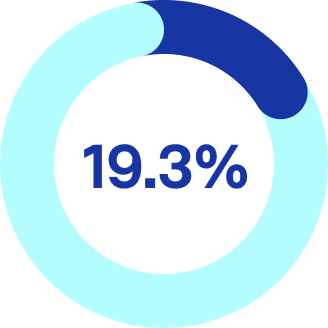
In a group of people with insomnia
20% had clinically significant depression levels16
In a group of people with insomnia
Feeling stressed, anxious or depressed
It’s no coincidence that if you’re going trough a difficult time emotionally, you may have trouble sleeping at night.
Relationship of family worries, work concerns and general life can all be responsible.14 In fact, research has shown a link between anxiety and depression and not being able to sleep at night5.
A bad night’s sleep reduces our ability to manage our emotions and impulses, increases and even worsens depression5. This is so common that the latest theme of World Sleep Day 2022 was “Quality sleep, Sound mind, Happy World”.
Too much screen time
While it’s tempting to keep going in the evening, devices that emit blue light such as your phone, laptop and tablet reduce your body’s ability to produce the sleep hormone melatonin and can keep you over-stimulated17.
A 2022 study has shown that 50% of adults now look at screens for 11 hours or more a day18. So, making small changes like switching on night mode, adjusting brightness settings, or even wearing blue light blocking glasses while using devices, may help to make a difference17.
Overstimulating your brain with alcohol, caffeine and nicotine
For example, alcohol lowers the amount of restorative sleep you get by disrupting your sleep cycle, and your body can get into a nightly pattern that can stay with you for some time after your last drink21.
Caffeine reduces your sleep time and your sleep quality by reducing the amount of time you spend in deep sleep – the deepest stage of sleep that helps to repare the body and strengthen immunity22,23.
Lastly, the nicotine found in cigarettes can stimulate the brain, keeping you awake for longer19.
Going through trauma
Some examples of traumatic events can be the death of a loved one, the end of an important relationship and even financial difficulties1. These stressful situations can lead to sleep problems such as reduced sleep quality and waking up multiple times in the middle of the night24.
Some people suffering from post-traumatic stress disorder (PTSD) may experience vivid and unsettling nightmares were they go through the trauma event over and over again24. In these instances, sleep patterns can be disrupted for years at a time24.
What else might be behind chronic insomnia?
Science suggests that people with chronic insomnia have an overactive brain at night, and research has helped us to better understand what’s going on.1,2
Parts of the brain that should be in sleep mode are instead still active, making it hard to fall asleep and stay asleep until morning.1,2
This lack of restorative sleep can leave you feeling tired and really not at your best during the day.1,2
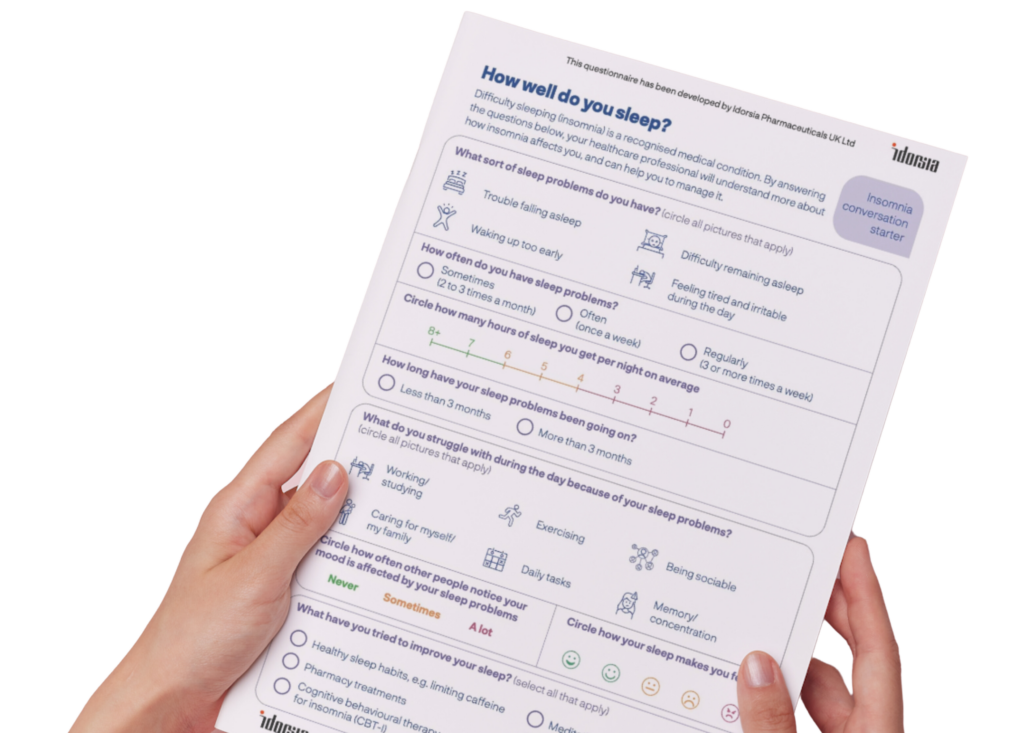
Are you ready for a fresh conversation about chronic insomnia?
Now we know more about what’s going on in chronic insomnia, we can rethink how to manage it. We can also understand why some approaches may not be the answer.25
Because although some insomnia medications have a sedative effect, which work by making you feel drowsy, they don’t give you the right kind of sleep you need to feel rested during the day.25
With a better understanding of chronic insomnia, we have new ways of thinking about how to manage it and get the restorative sleep you need to be at your best during the day.26-29
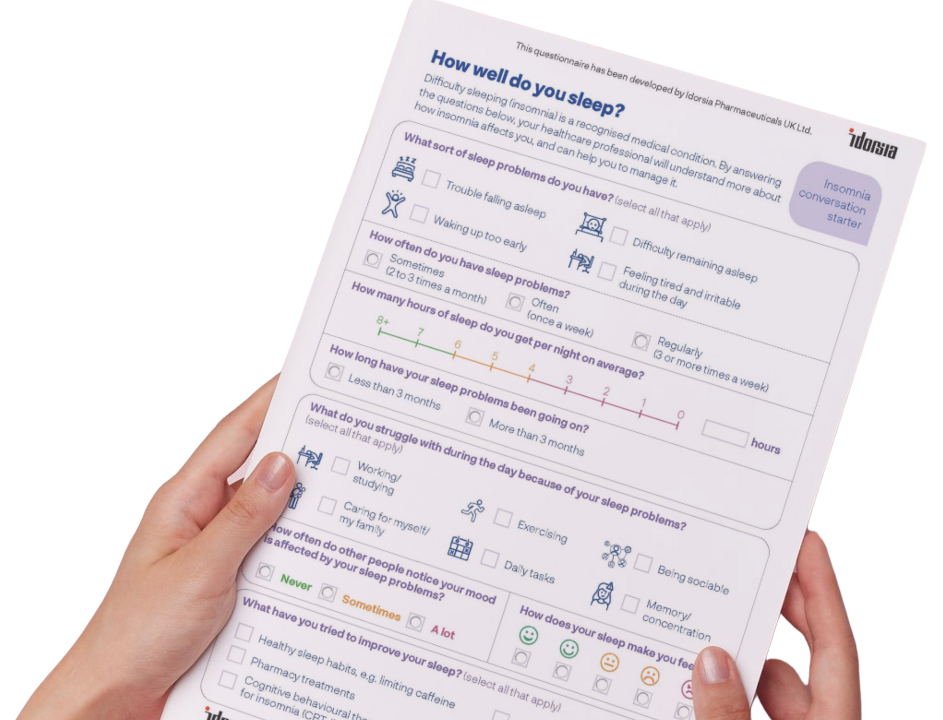
Have a fresh conversation about chronic insomnia
References
1.Riemann D, et al. Sleep Med Rev. 2010; 14(1): 19–31.
2. Killgore, et al. Neuroreport. 2013; 24(5): 233–40.
3. Reimann D, et al. J Sleep Res. 2017; 26(6): 675–700.
4. Bollu PC and Kaur H. Mo Med. 2019; 116(1): 68–75.
5. O’Leary K, et al. Cogn Emot. 2017;31(8): 1698–1706.
6..Wright CD, et al. Front Psychol. 2019; 10: 2498.
7. Vargas I, et al. Brain Sci. 2020; 10(2): 71.
8. Ellis JG, et al. J Psych Res. 2012; 46: 1278–1285.
9. Basta M, et al. Sleep Med Clin. 2017; 2(2): 279–291.
10. Roth T. J Clin Sleep Med. 2007; 3(5 suppl): S7–S10.
11 Sleep Foundation. Sleep Statistics. Available at: https://www.sleepfoundation.org/how-sleep-works/sleep-facts-statistics. Accessed August 2022.
12. Mallampalli MP and Carter CL. J Womens Health. 2014; 23(7): 553–562.
13. Pengo MF, et al. Chest. 2018; 154(1): 196–206.
14. Okechukwu, et al. Egypt J Neurol Psychiatry Neurosurg. 2022; 58:34.
15. Nofzinger, et al. Am J Psychiatry. 2004; 161(11):2126–2128.
16. Taylor DJ, et al. Sleep. 2007;30(2):213–218.
17. Schechter A, et al. J Psychiatr Res. 2018; 96: 196–202.
18. University of Leeds. UK screen use in 2022: a need for guidance. Available at: https://eprints.whiterose.ac.uk/184618/1/PolicyLeeds-Brief9_UK-screen-use-in-2022.pdf. Accessed August 2022.
19. Spadola CE, et al. Sleep. 2019; 42(11): zsz136.
20. O’Callaghan F. Risk Manag Healthc Policy. 2018; 11: 263–271.
21. Park SY, et al. Korean J Fam Med. 2015; 36(6): 294–299.
22. Clark I and Landolt HP. Sleep Med Rev. 2010; 31:70–78.
23. Besedovsky L. Pflugers Arch. 2012; 463(1): 121–137.
24. Babson KA and Feldner. J Anxiety Disord. 2010; 24(1): 1–15.
25. Winrow CJ and Renger JJ. British J of Pharm. 2014; 171(2): 283–293.
26. Chaput JP, et al. Nat Sci Sleep. 2018; 10: 421–430.
27. El-Mekkawy L, et al. Egypt J Neurol Psychiatry Neurosurg. 2022; 58(1): 1–7.
28. Drake CL, et al. J Clin Sleep Med. 2014; 10(7): 733–741.
29. Schutte-Rodin S, et al. J of Clin Sleep Med. 2008; 4(5): 487–504.
EUC-IDS-00086 April 2025